
Somatic Dance Therapy
In the rhythm of modern life, where the mind is often overloaded with anxiety and stress—the body is frequently neglected or even abused.
Neuroscience and psychology have shown that the body stores memories of traumatic experiences—and that the body itself is also the gateway to recovery and renewal when it is truly listened to.
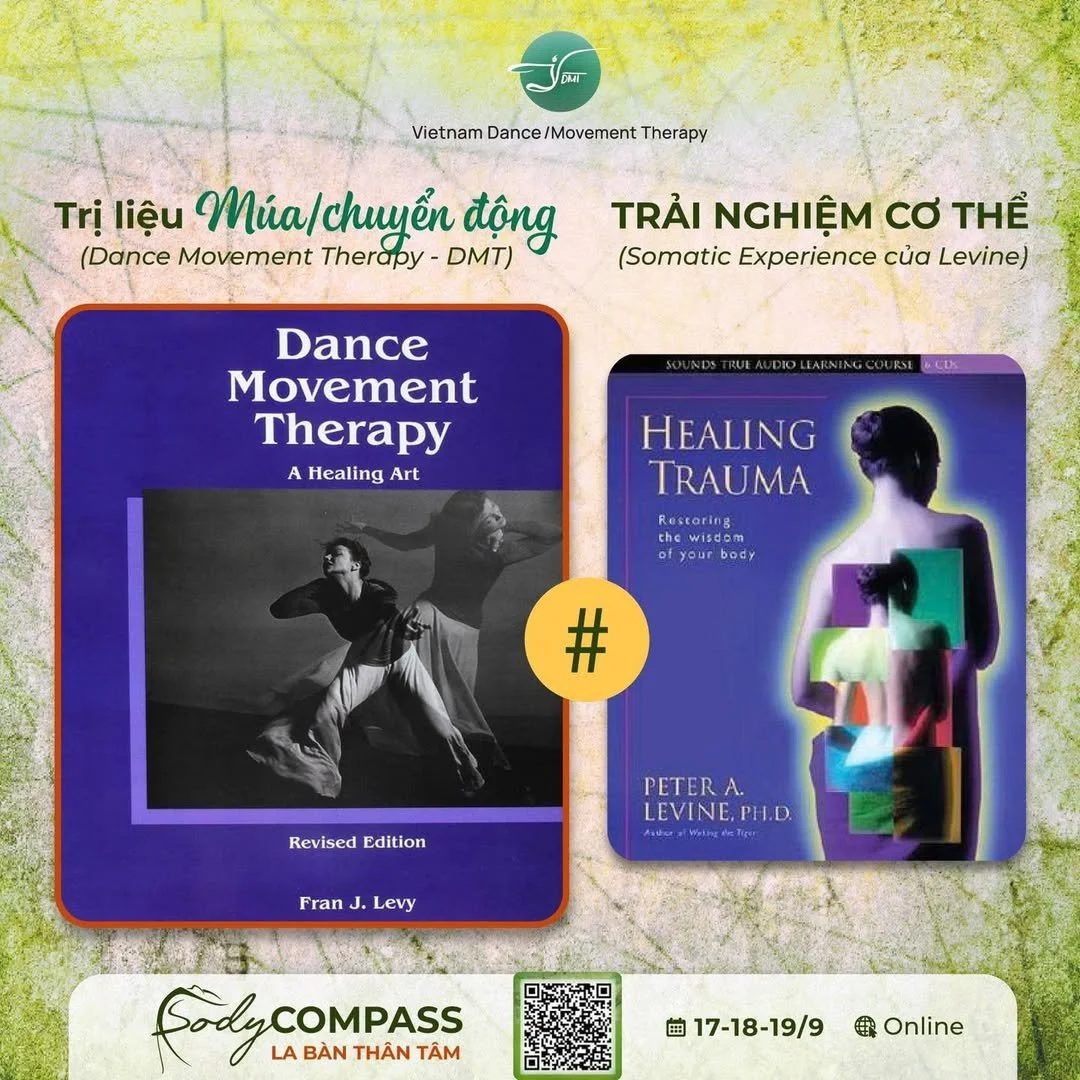
From this foundation emerged two internationally recognized therapeutic approaches—Dance/Movement Therapy (DMT) and Somatic Experiencing (SE). Each functions as a distinct language of the body, reaching into the deepest layers of emotion, mind, and memory.
Dance/Movement Therapy (DMT) offers a space where art and science meet—a space where individuals rediscover inner freedom, reconnect with community, and explore the intelligence of the body through rhythm, creativity, and expression, encompassing both trauma recovery and the cultivation of resilience.
Somatic Experiencing (SE) focuses on the journey of releasing psychological trauma that has become “frozen” in the body, restoring the capacity for self-regulation and reclaiming an internal sense of safety.
Dance/Movement Therapy (DMT)
History & Scientific Foundations
Origins: Emerged in the 1940s in the United States with pioneers such as Marian Chace and Trudi Schoop.
1966: The American Dance Therapy Association (ADTA) was established.
ADTA Definition: “The psychotherapeutic use of movement to promote emotional, cognitive, physical, and social integration of the individual.”
Koch et al. (2019): A meta-analysis of 266 studies involving over 16,000 participants showed that DMT reduces anxiety and depression while improving social connection and quality of life.
Areas of Application
Community mental health: Reducing stress, depression, and anxiety.
Healthcare & hospitals: Supporting cancer patients, individuals with chronic illness, psychological rehabilitation, and clinical mental health care.
Education & personal development: Enhancing social skills, creativity, and self-awareness.
Across ages, cultures, and health conditions: From pregnant women and infants to older adults—simply put, as long as one is breathing, one can dance.
Arts & community: Creating spaces for social connection through mindful movement and artistic creation.
Populations Served
Autistic children and children with behavioral challenges
Adults experiencing anxiety, depression, trauma, or violence
Older adults and individuals recovering from injury
Survivors of violence, postpartum women
Community groups seeking connection and creativity
Key Characteristics
Uses the body’s creative language to express emotions and lived experience
Integrates art and science to support holistic well-being—Body, Mind, Emotion, and Social connection
Guided by clear therapeutic goals and aligned with international ethical and professional standards
Somatic Experiencing (SE)
History & Scientific Foundations
Developed by Dr. Peter Levine in the 1970s
Polyvagal Theory (Stephen Porges, 2011):
The nervous system operates in three primary states: Safety – Fight/Flight – Freeze
SE supports the body in releasing “frozen” survival energy and restoring a sense of internal safety
Emphasizes interoception—the capacity to listen to internal bodily signals
(This closely aligns with Barbara Mettler’s philosophy and will be explored further in another piece.)
Areas of Application
PTSD & trauma: Violence, abuse, war, natural disasters, accidents
Anxiety disorders & chronic stress: Panic attacks, insomnia, autonomic nervous system dysregulation
Clinical mental health support: Integrated with traditional psychotherapy
Recovery after severe illness or surgery: Re-establishing nervous system balance
Populations Served
Survivors of PTSD, violence, and abuse
Individuals experiencing chronic anxiety and stress
Those seeking to develop self-regulation skills and reclaim internal safety
Key Characteristics
A gentle process that avoids retraumatization
Spontaneous movement arises when the body is ready to release traumatic energy
Empowers individuals to reclaim agency over their body and emotions
Conclusion
Dance/Movement Therapy (DMT):
A harmonious dance of connection and creativity, integrating art and science to support comprehensive mental and emotional health—addressing Body, Mind, Emotion, and Soul.Somatic Experiencing (SE):
A sequence of fundamental movements that facilitate trauma release and restore nervous system balance.
Each approach has its own distinct qualities and focus, yet both place bodily movement at the center as a bridge between emotion and mind—affirming that:
“When the body moves, the mind and emotions are also released and renewed.”
