
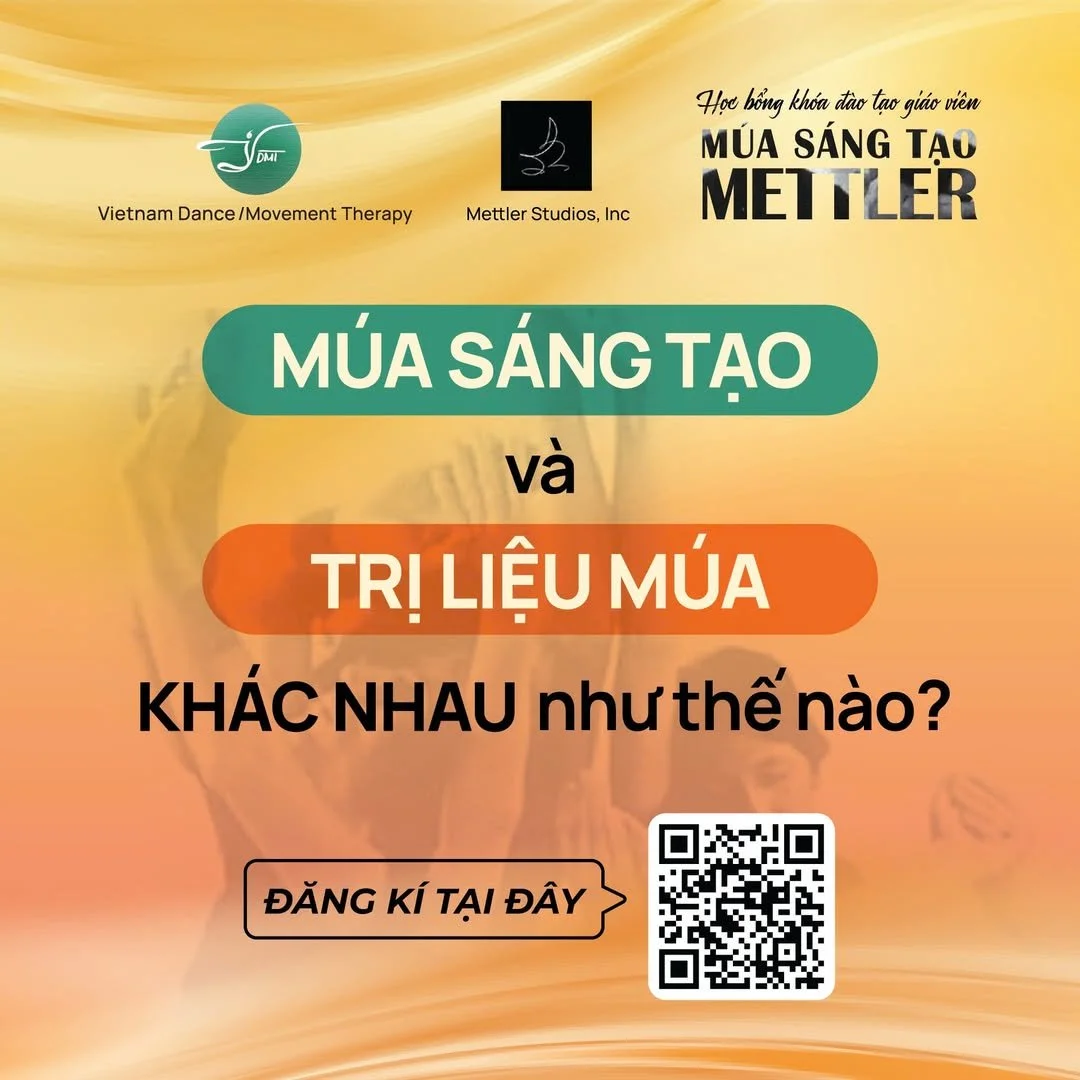
Creative Dance vs Dance Therapy
HISTORY & ORIGINS
Dance/Movement Therapy (DMT)
In 1966, the American Dance Therapy Association (ADTA) was founded by pioneering artist Marian Chace, marking the official birth of Dance/Movement Therapy as a psychotherapeutic modality. Since then, DMT has been applied in psychiatric hospitals, healthcare facilities, schools, and community settings, and has become a clinically recognized therapeutic profession within the U.S. mental health system.
METTLER-BASED CREATIVE DANCE
Beginning in the 1940s, educator and artist Barbara Mettler emerged as a key figure in the field of somatic and creative dance.
Her approach was simple, grounded in the body’s natural capacities, and centered on individual and collective creativity.
What is particularly notable is that many psychotherapists, psychiatrists, social workers, and educators around the world studied Mettler-based Creative Dance not to become dancers, but to apply it in their professional work—such as special education, healthcare, mental health support, community development, and social work. They recognized that natural connection and healing often emerge through co-creation and expression via the body’s organic movement—without the need for dance technique.
ORIGINAL QUOTATION FROM METTLER — ON ART OR THERAPY?
(From Creative Dance—Art or Therapy? (1990), Barbara Mettler, vol. 12, pp. 95–100)
“Dance can take many forms and serve many purposes. Dance can be entertainment, performance, education, psychotherapy, or religion. In its pure and basic form, dance is an art — the expressive use of body movement for communication and connection. Dance is a fundamental human need.”
This is the foundation for distinguishing Creative Dance from Dance/Movement Therapy.
ESSENTIAL DIFFERENCES
CREATIVE DANCE
By nature, Creative Dance is simply an art form, with the following aims:
To awaken creativity
Free expression
Increased body awareness
Aesthetic experience and connection
Democratic, non-judgmental, accessible to all
According to Mettler:
“Creative dance is not therapy. But it can have therapeutic effects.”
It is not therapy.
It does not aim to treat trauma or psychological disorders.
DANCE/MOVEMENT THERAPY (CLINICAL PRACTICE)
Dance/Movement Therapy is a psychotherapeutic approach that uses dance and movement with clearly defined therapeutic goals.
Goal:
Treat anxiety and depression
Process trauma
Regulate the nervous system
Support special populations (autism, ADHD, PTSD, dementia, etc.)
Foster emotional and social development
Characteristic:
DMT is a scientifically grounded form of psychotherapy that includes:
Treatment goals
Assessment processes
Clinical interventions
Therapeutic documentation
Degree and licensure requirements, with therapists holding at minimum a master’s degree and completing over 750 hours of supervised clinical practice
ADTA defines Dance/Movement Therapy as the use of dance/movement as a psychotherapeutic tool that integrates both verbal language and body movement language.
CAN DANCE/MOVEMENT THERAPY USE CREATIVE DANCE?
Yes—but only as one tool among many that a dance/movement therapist may flexibly apply depending on the needs and nature of each session.
These tools may include: Creative Dance, improvisation, folk dance, ballet, Authentic Movement, Laban/Bartenieff, somatic practices, ritual forms, Tai Chi, martial arts, yoga, and more.
In DMT, the therapeutic purpose lies in the therapeutic relationship, movement analysis, and clinical intervention—not in the dance itself or in dance technique.
CONCLUSION
Creative Dance helps people transcend, orienting toward art, creativity, and expression.
Dance/Movement Therapy helps people heal and recover, orienting toward therapy, healing, and psychological stabilization.
They meet in the shared language of movement, but clearly diverge in purpose, responsibility, and the professional competencies of the facilitator.
When properly understood and clearly distinguished, they can complement one another in a flexible and highly effective way.
